Something shifted in this conflict, and it is easy to miss if you are only looking at the surface. Most wars introduce new technology. Faster weapons. Better targeting. More range. This one feels different. Not because of what is being used, but because of how decisions are being made. For the first time, we are watching a conflict where artificial intelligence is actively compressing the time between seeing, deciding, and acting… while the situation itself is still unfolding. This is not post-analysis. This is midstream.
The easiest place to see this is in the math.
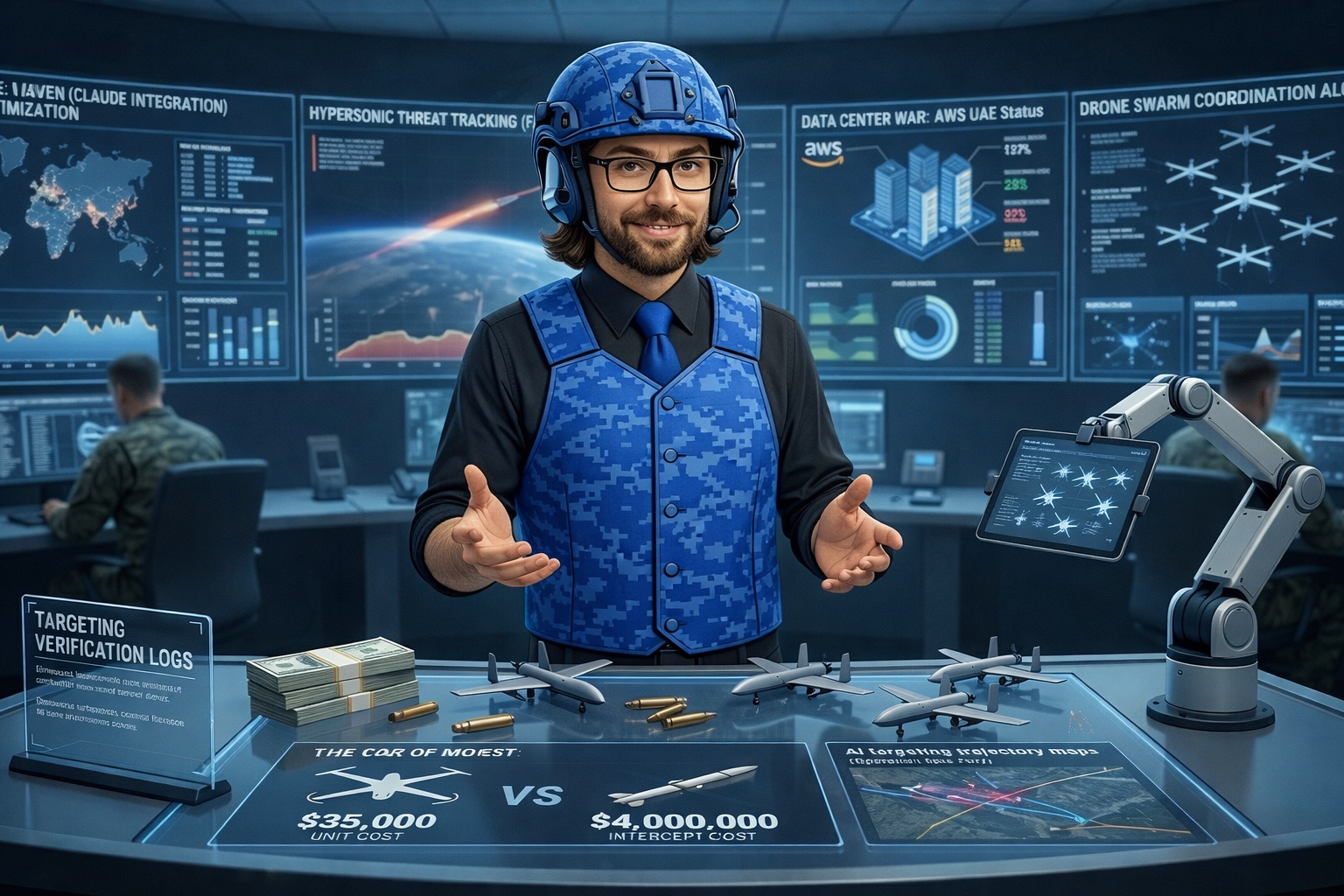
A $35,000 drone forces a defensive response that can cost millions. That gap is not just inefficient. It compounds. 
Cheap systems are not trying to win outright. They are forcing expensive reactions, over and over, until the system behind them starts to strain.
At the same time, those drones are not operating blindly.
AI systems are filtering satellite feeds, sensor data, and battlefield signals in seconds. What used to take hours or days now happens almost instantly. 
Humans are still involved. But they are no longer the ones searching for the signal.
They are reacting to what has already been surfaced.
This is where the shift becomes clearer.
AI is shortening what military planners call the “kill chain.” The process from identifying a target to acting on it. 
That chain used to move at human speed.
Now it moves at system speed.
Thousands of targets can be analyzed and acted on in compressed timeframes that were not previously possible. 
At the same time, autonomy is creeping forward.
Drones can navigate without signals. Swarms can coordinate without direct control. Systems can adapt in motion rather than follow fixed instructions.
Even information itself has become a battlefield.
AI-generated content, synthetic media, and coordinated digital campaigns are being deployed alongside physical systems to shape perception in real time. 
And underneath all of it, infrastructure is now exposed.
Data centers, networks, and compute are no longer background systems. They are becoming targets. 
The “cloud” is no longer abstract when physical systems depend on it to function.
This is not just about better weapons.
It is about timing.
When decisions start happening faster than humans can fully process them, control begins to shift.
Not suddenly. Gradually.
At first, the system filters the data. Then it suggests the decision. Then it becomes difficult to disagree with the suggestion, because the system has already seen more than any individual could.
This is how the role changes.
From decision-maker… to validator… to observer.
And this is happening while the conflict is still evolving.
Not after.
It is too early to call this a fully autonomous war.
Humans are still making final calls. That line is still being held, at least for now. 
But the pressure on that line is increasing.
Faster systems create expectations. Faster decisions create dependencies. Dependencies are hard to reverse once they become normal.
What this conflict is showing is not a finished state.
It is a direction.
A world where intelligence is no longer just used to understand the battlefield…
but to shape it, continuously, while it is still unfolding.
And once that becomes normal, the question is no longer whether AI is involved.
It becomes whether anything can happen without it.
Dr.WinMac explores the infrastructure and automation changes that affect everyone, explained without jargon.
Back to Blog